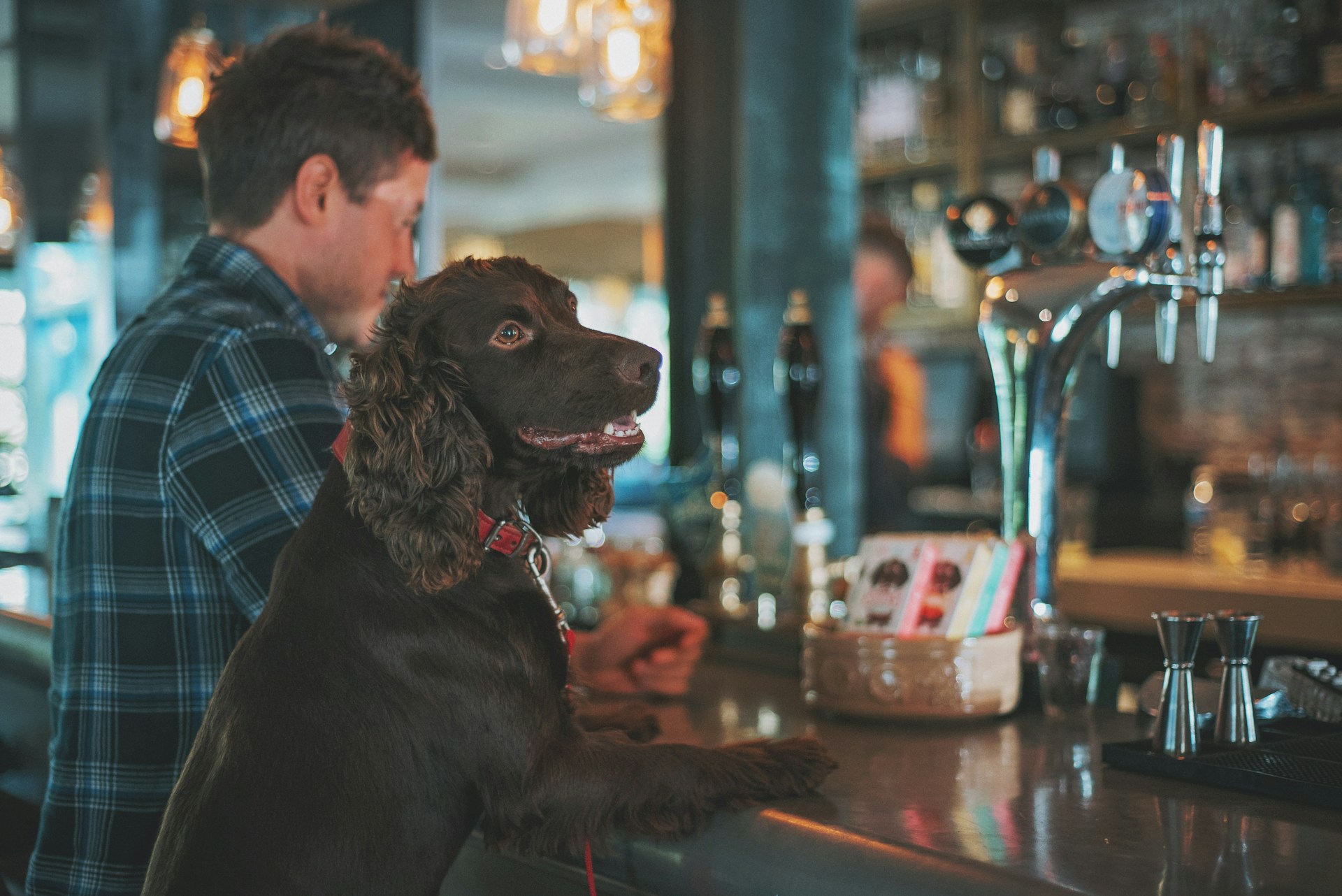
JD Wetherspoon is one of the UK’s largest pub chains, known for low prices, large-format pubs, and converting historic or unusual buildings such as cinemas, banks, and churches into pubs. It was founded in 1979 by Sir Tim Martin and welcomes guests across the UK, Ireland, and a few spots in Spain as of 2026. The most famous JD Wetherspoon pub is widely considered to be The Palladium in Llandudno, Wales, which occupies a 1920s Baroque-style theatre.
Changes in Policy
JD Wetherspoon was featured by the BBC in February 2026 due to its assistance dog policy. JDW claims that 15 staff members were attacked by dogs in 2025 compared to two back in 2020. That is suggested as the reason for the revision of their assistance dog policy. The management and staff at Wetherspoon locations are instructed to ask assistance dog handlers for an ID card and proof of their dog’s training. This was presented as "consistent with established regulations such as proof of age in pubs and blue badges for parking." JDW headquarters voiced concerns about balancing the needs of disabled individuals with the safety of guests, which is understandable given the increase in dog-related attacks.
ID at the Door
If you are an assistance dog handler who plans to visit a JDW pub anytime soon, be aware that you may be asked for identification at the door. Wetherspoon staff have reportedly asked their guests for identification issued by the Assistance Dogs UK (ADUK) charity. Such a requirement is not consistent with the UK laws that we explain here, a view that ADUK also shared with the BBC. Reportedly, the Equality and Human Rights Commission wrote to JD Wetherspoon, but it is unclear what came of it.
JD Wetherspoon said: "We consider the requirement for assistance dogs to have accredited training from ADUK member organisations to be a reasonable adjustment to our policy, as required by the relevant legislation." Liberal Democrat MP Steve Darling expressed concern about how the policy affects people with invisible disabilities like PTSD. Central management did not respond to the comments from Darling. More importantly, the JDW website and its F.A.Q. (frequently asked questions) page reveal nothing about their assistance dog policy.
The Problem with Fake Assistance Dogs
Charities allegedly see an increase in reports of people misrepresenting their pet dogs as fully-trained and safe assistance dogs. Because the UK has no central government registry or compulsory identification system for assistance dogs, tracking cases where individuals present a pet as an assistance animal relies primarily on survey data and industry self-reporting rather than official data sets.
In evidence submitted to UK Parliamentary Committees in May 2024 regarding the Equality Act 2010, Assistance Dogs UK (ADUK) stated that the lack of standardized identification creates friction and insecurity for businesses and handlers alike. Law firms like Stephensons reported a 25% increase in cases where assistance dog handlers confront business owners in court on the grounds of discrimination and refusal of access. In international studies capturing handler experiences, roughly 65% of assistance dog handlers reported encountering skepticism or hostility from business owners explicitly because of the rise of fake assistance dogs.
Visiting a JD Wetherspoon Pu
While not legally required, we encourage you to have some proof of completed assistance training that can be easily verified by the staff. Our friends at the ServiceDog Training School International (SDTSI) offer online courses that make assistance/service dog training more affordable and accessible. If you want to self-train your paw partner to be a reliable assistance dog and behave properly in pubs, hotels, and other public spaces, then we invite you to explore your options with SDTSI. Should you prefer to work with Assistance Dogs UK (ADUK), then you can find their list of member organisations online. Working with SDTSI and ADUK can provide you with a certificate for completed training, and you can get an ID card, which may be helpful for your next visit to the pub.
Public Discussion
The discussion surrounding JD Wetherspoon's assistance dog policy and the Equality and Human Rights Commission (EHRC) notice triggered a very active debate on social media. Commenters were divided between legal/disability rights concerns and practical frustrations with fake assistance/service animals. Several commenters pointed out that demanding ID from a specific third-party charity (such as Assistance Dogs UK) violates the law, as there is no statutory requirement in the UK for assistance dogs to carry formal identification. Many people highlighted how exhausting it is for disabled individuals to constantly obtain and pay for non-standardized third-party cards or register private medical information with multiple non-governmental organisations just to access basic public spaces.
A prominent argument supported Wetherspoon’s attempt to filter out people who buy cheap "assistance dog" vests online to bring untrained pets or emotional support animals into pubs. Many commenters noted that irresponsible pet owners claiming their pets are assistance animals are the root cause, ultimately forcing businesses into heavy-handed enforcement that hurts genuine assistance dog users. It should be emphasised that current law already permits businesses to remove any dog that is disruptive, aggressive, or misbehaving, regardless of whether the owner claims it is an assistance animal.
A popular suggestion was that if ID is required, the UK government should create a unified, official scheme (similar to the Blue Badge parking system) rather than relying on unregulated charities or commercial vendors. Only time will tell how this sensitive issue develops and whether the UK government will establish a unified framework.