For some people, travel is a way of life, while for others it is a necessity related to work or visiting family. Assistance dog handlers belong to a separate group for whom traveling goes far beyond the usual trip preparation. It can be an intense experience, full of emotion! One missed step or a single “no” from airline or airport staff could mean being separated from their assistance dog.
Assistance dogs are individually trained to perform tasks that help mitigate the symptoms of a disability. Their support is invaluable, and being forced to leave them behind can be an extremely frustrating experience for handlers.
Due to their status as ‘medical equipment’ rather than pets, assistance dogs are entitled to access to public places, including airports. Because of these rights, assistance dogs are expected to be more than just “well-behaved” in public settings, like airports. They must be an ambassador of calm.
This article is for anyone planning to fly with their assistance dog and wanting to ensure their loyal paw friend meets the behavioral expectations from the car park to the cabin. Following these guidelines will help make your trip smoother and more positive for both you and your assistance dog.
The Role of Assistance Dogs
Assistance dogs are individually trained to perform specific tasks directly related to a person’s disability, whether it is physical, neurological, mental, or sensory. Common types of assistance dogs include, but are not limited to, guide dogs for visually impaired individuals, hearing dogs for people with hearing impairments, medical alert dogs that notify their handlers of the onset of medical episodes like too low or high blood sugar levels, and psychiatric support dogs for people with mental health conditions such as anxiety or PTSD.
Unlike pets, assistance dogs are trained to maintain constant focus on their handler. They are able to anticipate their handler’s needs, prevent potential medical emergencies, or respond immediately when an issue arises. For example, a medical alert dog might warn their handler of a dangerously low blood sugar level before symptoms occur, while a psychiatric support dog can provide grounding or interrupt harmful behaviors during a panic episode.
This level of training requires patience, consistency, and reinforcement over time, which ensures the dog can function reliably in unpredictable public environments, including busy airports.
Air Travel Regulations in the UK and EU
In the UK, the Civil Aviation Authority (CAA) protects the rights of handlers traveling with assistance dogs. It helps ensure they are not unfairly denied boarding and that their dogs are accommodated appropriately during air travel. For handlers looking for detailed guidance, documents such as “Annex 1 - Recognised Assistance Dogs: Summary of Responses to the Call for Evidence” may be of interest.
Across EU member states, regulations such as EU 1107/2006 (Regulation (EC) No 1107/2006 of the European Parliament and of the Council of 5 July 2006 concerning the rights of disabled persons and persons with reduced mobility when travelling by air (Text with EEA relevance)) guarantee similar protections. These laws not only protect handlers’ rights to travel with their assistance dogs but also set standards for identification, certification, and documentation that may be requested by airlines or airport authorities. Handlers should always familiarize themselves with local regulations and the service dog policy of the airline of interest ahead of time to avoid delays or misunderstandings at check-in and security.
It is also crucial to understand the difference between assistance dogs and pets in the context of air travel. Pets generally travel for companionship, and they are subject to different policies than assistance dogs. Some airlines may not accept pets on certain routes or at all, and they often have strict requirements regarding approved carriers, maximum weight limits, applicable fees, and necessary health documentation.
Assistance dogs, on the other hand, are considered medical equipment and are typically exempt from many of the restrictions applied to pets. However, this does not mean their acceptance is always straightforward. Depending on the airline and the specific route, only certain types of assistance dogs may be recognized. For example, some airlines still classify psychiatric service dogs in the same category as emotional support animals, which means they are only permitted to travel in the passenger cabin on flights to or from the United States.
Additionally, some airlines require assistance dogs to be trained by specific organizations to be accommodated in the cabin, such as the Assistance Dogs International (ADI) or the International Guide Dog Federation (IGDF).
Being familiar with the local laws and airlines’ policies helps handlers advocate for their dogs’ rights as working animals, and helps make the trip less stressful and more positive.
The Psychology of the “Working Mindset”
Before stepping into busy terminals like Heathrow or Charles de Gaulle, both the handler and their assistance dog need to make a mental shift. This is crucial because traveling with an assistance dog is very different from a regular outing to a public setting, such as a grocery store or café.
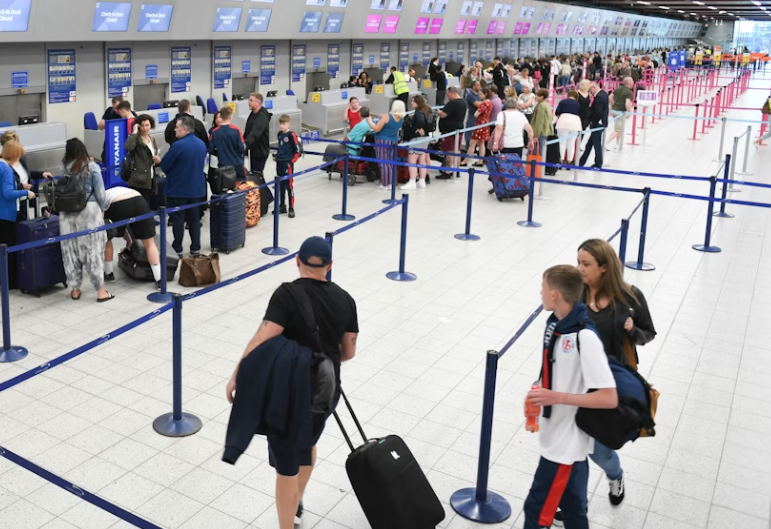
Airports are intense, fast-moving environments, filled with unfamiliar people, loud sounds, different smells, and rolling luggage of all shapes and sizes. When you add immense crowds flowing in every direction, the entire experience can quickly become a lot to process for both dogs and humans. Without the right preparation, this sensory overload can be overwhelming. That’s why the “working mindset” matters so much. It helps the dog understand that this is not a place for exploration or interaction, but an area where focus and teamwork are essential.
Adopting a working mindset means that both parts of the team are calm, attentive, and attuned to each other. The canine’s role is to stay connected to the handler, follow cues reliably, and ignore distractions, regardless of how busy or unfamiliar the surroundings may be.
At the same time, the handler’s emotional state plays a crucial role in the team’s overall experience. Dogs are incredibly sensitive to changes in our emotions, and even subtle stress can affect their behavior. By staying steady and confident, handlers can positively influence their assistance dogs’ calmness and responsiveness in dynamic environments and situations.
Behavioral Expectations
If you want to ensure a successful trip and a positive airport experience when traveling with your assistance dog, your dog must remain calm and focused. Appropriate public manners and steady, composed behavior are the foundation of a smooth and stress-free journey.
In busy terminals, assistance dogs must remain composed regardless of the bustling crowds, sudden noises, or unexpected movements around them. Even small distractions, like the clatter of a luggage trolley, food smells, or another dog passing by, should not interrupt their attention or work.
Minimizing vocalization is equally important. Barking, whining, or other loud noises can quickly become disruptive in confined spaces and draw unwanted attention. Barking should only occur if it is part of a trained task, such as alerting to specific sounds or barking on command. Even then, this task typically involves one or two brief barks rather than continuous barking.
Physical control is also crucial, as assistance dogs should walk politely on a leash, remain close to their handler, and avoid jumping on people. In practice, a properly trained assistance dog moves through the airport quietly and confidently, without attracting attention, while remaining fully responsive to their handler.
It’s important to note that aircraft-specific training comes only after a dog has mastered obedience training and task-based skills. Once the dog is well-mannered in public, reliably performs their tasks, and is consistent in daily life, they can gradually be introduced to aircraft experiences, like staying calm in confined spaces, near seats, and during takeoff, landing, or turbulence.
At this stage, the goal is not to teach the dog new behaviors, but rather help them apply what they already know in a more challenging environment, while remaining focused.
Preparing Your Dog for the Airport
A smooth, stress-free airport experience actually starts long before you ever set foot in the terminal. You can think of it as building a foundation. When you and your dog are both prepared, you move with a lot more confidence and a lot less anxiety. The secret is making the "strange" feel totally routine.
Before your trip, you may try to simulate the chaos you will probably experience at the airport. To do that, try to find local spots that mimic the airport's energy. For example, walking through busy streets, navigating a crowded train station, or even hanging out at a shopping center can help your dog get used to the weird sounds, smells, and surfaces they'll face later.
The idea is to have the airport feel like just another regular day in a public setting, not an overwhelming new world.
It’s also worth practicing for the specific triggers that only appear at the airport. Get your dog comfortable around:
- The rattle of luggage trolleys and moving walkways;
- Swooshing automatic doors;
- The constant hum of overhead announcements.
Security checks can be the most stressful part, so it’s advisable to practice staying calm while approaching metal detectors or interacting with staff. Keep any interactions positive and calm, whether that’s treats, praise, or a favorite quiet toy.
This will teach your dog to stay focused on you, even when things get hectic.
Being physically prepared for the flight is also an important part of the process you shouldn’t neglect.
Your paw friend should be well-rested and have had a chance to relieve themselves. Give them plenty of opportunities to stretch their legs and do their business one last time before you head to the gate. That said, you may want to check the relief areas at the airport in advance.
They also should be fed but lightly. We recommend giving them a small meal a few hours before departure. You don't want them flying on a full stomach (which can cause nausea), but they shouldn't be starving either.
It’s also important to give them enough water so that they stay hydrated, but you should limit large amounts right before you check in.
If your dog lacks experience in airport environments, consider bringing along comfy items from home, such as a familiar blanket, mat, or favorite toy that can provide an extra sense of security. If you can, plan for short breaks during your travel day so your dog can take a breath, have some water, and reset.
Mental preparation is just as important as the physical side of travel. By practicing "settle" commands and walking through potential scenarios in advance, you help your dog understand exactly what is expected of them.
The goal is to make the airport feel like a familiar routine rather than an overwhelming environment. When the surroundings feel predictable, your furry friend is far more likely to remain calm and composed.
Security checks are often the most intimidating part of the journey for both handler and dog. Assistance dogs must remain calm while their documentation is checked, including a certificate such as proof of training, a health certificate or pet passport, microchip number, vaccinations, and other paperwork based on the route.
They may also need to pass through metal detectors, undergo sniff checks, or remain still during brief physical inspections. Some airports may require dogs to step onto a platform for additional screening, while others might ask handlers to remove any training gear, such as a harness, temporarily. That said, exposure to similar procedures at home or in training environments can make the experience at airports much smoother. Being familiar with what will happen in advance helps reduce surprises for both the handler and the dog.
It’s important to stay tuned in to your dog throughout the journey. Using familiar cues will help them understand that everything is still part of a normal routine, even in a busy terminal. If you notice they’re starting to feel uneasy or agitated, a calm word or a gentle pat can help keep them grounded.
Make sure to have your paperwork ready and easy to reach before you talk to airport staff, as this will help prevent unnecessary delays. It’s also recommended to get to security ahead of time, so that everything goes smoothly and without any rush. If you have to rush, your dog is likely to feel that pressure too.
Most importantly, try to keep your own stress in check. Dogs are incredibly perceptive and will pick up on your energy. By remaining composed and using a calm and steady voice, you give your dog the confidence they need to stay focused and do their job reliably.
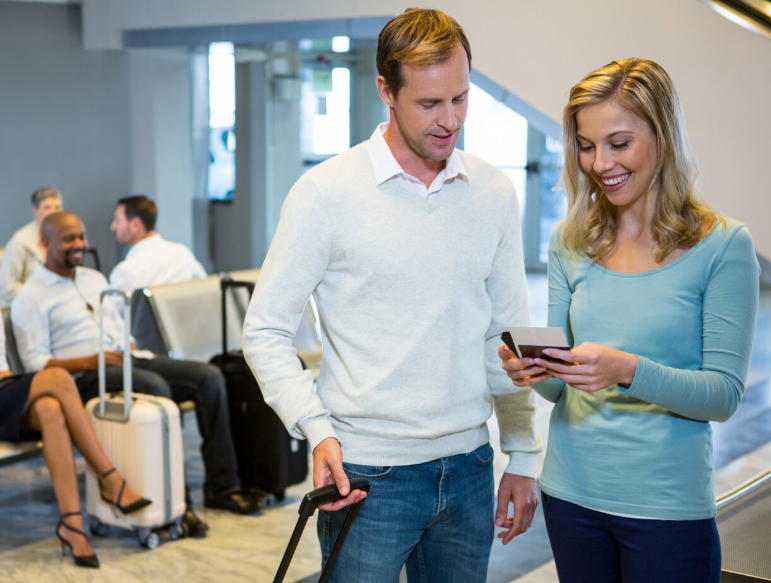
In-Terminal Etiquette
Once you’re inside the terminal, the focus shifts to navigating the crowds. Your dog should walk calmly on a short leash, stay close to you, and ignore all types of distractions, including the noise of luggage, other pets, or passing travelers, some of whom may even try to initiate interaction. If your assistance animal gets distracted, remember that a quick and gentle redirection is usually all it takes to keep them on track.
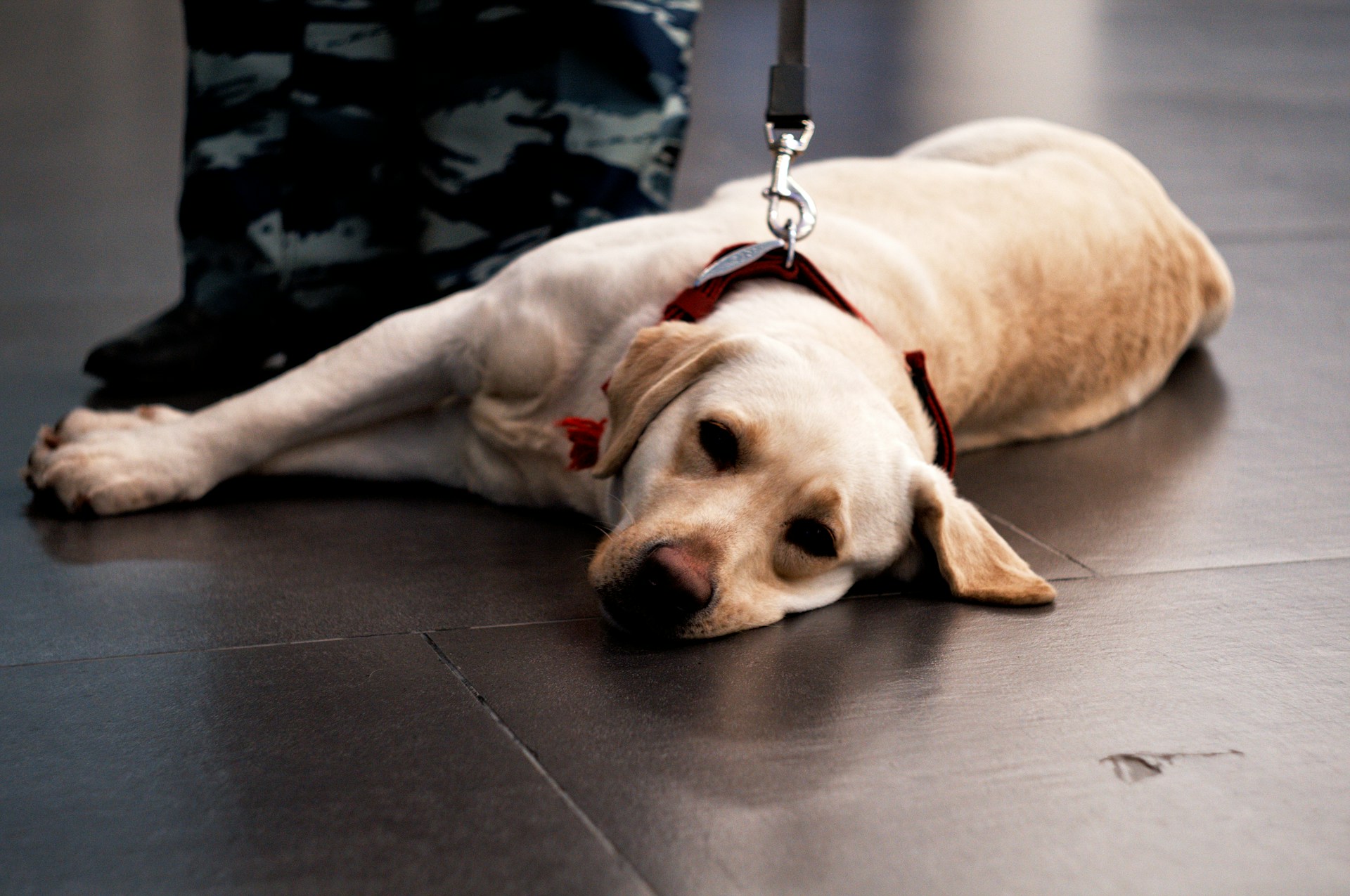
Whether you’re waiting in line, at the gate, or grabbing a coffee, the goal is for your dog to remain quiet and calm. It’s best if they sit or lie down by your side and avoid looking for attention or food from people passing by. To make this easier, you can use a familiar mat or blanket, which acts as a clear visual signal that it’s "settle" time.
Practical things like knowing where the relief areas are and timing bathroom breaks will keep your dog comfortable and help avoid any issues. Practicing these behaviors in busy public spaces before your trip can make a huge difference, as it helps your dog stay composed even in a hectic airport.
Airline Considerations
Assistance dog handlers should always follow airlines’ specific policies for traveling with service/assistance dogs to ensure compliance and a smooth journey. Keep in mind that each airline runs its own assistance dog policy, which may vary based on the specific route. Some carriers differentiate between their regulations for flying with assistance dogs to/from the US and to/from other countries. That said, make sure to carefully review their website and contact their representatives before booking your flight.
Familiarize yourself with all travel forms you need to complete and submit. Make sure your dog is up-to-date on all necessary vaccinations, has a valid pet passport or health certificate (depending on your route), and is microchipped. Tapeworm treatments and antibody tests may also be required for entering certain destinations.
Once you’re on the plane, your main priority should be keeping your dog calm and comfortable. Assistance dogs are permitted to travel without a carrier in the space under the seat in front of their handler. They must not obstruct access to the aisle or exit rows.
If your assistance dog is large, it may be necessary to book an extra seat or make arrangements with the airline in advance. Airline staff may offer you a bulkhead seat, which provides extra legroom. Alternatively, they may advise rebooking to a flight with more available space. If you’re flying with a large assistance/service dog, the following article may be of interest to you: Flying With A Large Service Dog.
Takeoff, landing, and turbulence can be a little strange for a dog, especially in a confined space. That said, you may consider bringing familiar items, like a blanket or toy, to help them feel secure during the flight. You can also praise them and pet them gently or use subtle hand signals to keep them focused on you during loud announcements or bumpy moments.
If you’ve done the preparation we’ve discussed earlier, your dog will already be more familiar with these kinds of environments. Still, it’s important to keep an eye out for any signs of stress, even subtle ones. If your paw companion appears to be uneasy, gently calming them or using a quick distraction is usually enough to keep them settled. A dog that stays focused on their handler helps make the flight a much smoother experience for everyone on board.
Helpful Tasks in the Airport
To ensure navigating an airport is a routine and even positive experience, rather than an overwhelming one, certain tasks should be considered.
Commands like “back up” help create personal space in crowded areas, while “down” keeps the dog calm and settled during lines, security checks, or waiting near gates.
Focus training, including “watch me” or “look at me”, can redirect the dog’s attention if distractions become overwhelming, and ensure they remain alert to the handler’s needs rather than the environment.
For handlers experiencing panic attacks or severe anxiety that worsens in crowded places like airports, tasks such as deep pressure therapy can come in handy. They can be performed in different ways based on the person’s needs, where the most common are lying on the handler’s lap/chest and resting their chin on the handler’s lap.
Other useful tasks include retrieving items, like dropped boarding passes or small personal items, and guiding the handler through busy terminals or toward seating areas.
For handlers with mobility or balance challenges, dogs can offer brace support to assist with stability when standing in queues or navigating stairs.
Practicing these tasks in quieter environments before traveling helps the dog stay reliable, focused, and confident when exposed to real airport situations and stimuli.
Identification and Gear
While assistance dogs in the UK are not legally required to wear any type of training or identification, it has proven very useful in public settings when handlers seek accommodations for their dogs. When it comes to traveling by air, many airlines prefer, and some of them even require, visible identification.
A harness, vest, ID card, or tag can help notify airline staff and the public that a dog is a working animal who has undergone proper training and is currently on duty. While unwanted attention or attempts at interaction can still occur, training or identification equipment can be very helpful in setting boundaries.
It’s also important to ensure that any gear is comfortable, fits properly, and does not restrict movement or interfere with the dog’s tasks. Last but not least, practicing with the gear in everyday public settings can help the dog remain focused and calm when wearing it during travel.