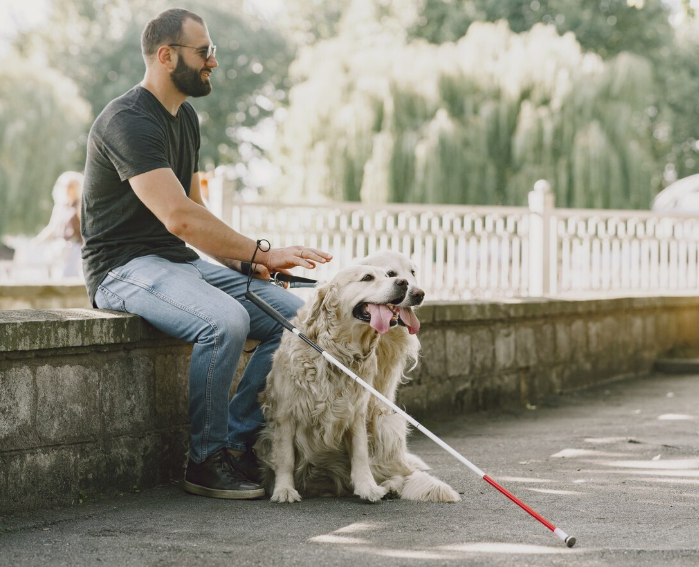
For many people, the thought of traveling with a dog brings both comfort and concern. It’s reassuring to have your beloved paw companion by your side; on the other hand, airports and airplanes can be overwhelming environments, full of distractions and procedures to follow.
While the decision to bring your pet on a plane depends on many factors, such as the duration of the flight or your stay, the costs involved, the availability of friends or family who could look after your pet, or the option of a pet hotel, as well as you and your pet’s ability to cope with separation, this isn’t the case for service dogs.
For individuals who rely on service dogs, that bond is far more than emotional. These dogs aren’t just beloved companions but reliable assistants who provide safety, enhance their owners’ confidence, and independence every day. The idea of leaving their service dog behind and traveling without them is unthinkable for handlers.
When it comes to guide dogs specifically, their support can be absolutely essential and even life-saving! So, what happens when it’s time to fly? Are individuals accompanied by guide dogs allowed to bring them on board, and under what conditions? Let’s find out!
What Are Guide Dogs?
People who are blind or visually impaired can navigate the world with confidence and safety thanks to guide dogs. These are specially trained service animals who serve as their handler's eyes.
Their role, however, goes beyond spotting doors, stairs, and crossings, avoiding obstacles and stopping at curbs. In addition to serving as ‘mentors’, they give many people emotional support and a sense of autonomy that they may be unable to get otherwise.
Typically, guide dogs are trained to make wise decisions, obey commands exactly, and maintain composure in hectic situations. In rare cases, they may even disobey orders if following them will endanger their owner.
Their dedication, reliability, and awareness make them invaluable assistants for their owners!

Legal Rights and Protections
Guide dogs are legally recognized assistance/service dogs in many parts of the world, including but not limited to the United States, Canada, the United Kingdom, and throughout the European Union.
Countries whose legislation protects assistance/service dogs generally recognize guide dogs as one of the most common and essential types of support animals. In some cases, local laws specifically cover guide dogs but do not mention other types of assistance/service dogs (at least not directly), leaving their legal recognition open to interpretation.
Local laws protecting individuals with disabilities, including those with visual impairments, ensure that people who rely on service dogs, such as guide dogs, can travel, work, and participate in public life without unnecessary barriers and enjoy the same level of inclusivity as anyone else.
In the United States, the Americans with Disabilities Act (ADA) protects the rights of people with disabilities to be accompanied by their service dogs in public settings.
In the United Kingdom, the Equality Act 2010 ensures that people accompanied by assistance dogs have the same access to goods and services as the general public.
In Canada, provincial laws protect the rights of individuals with disabilities, including their right to be accompanied by a service dog in public.
In Australia, the Disability Discrimination Act 1992 protects the rights of individuals with disabilities and ensures they are equally treated when accompanied by an assistance animal.
Similar protections exist in other countries under their own disability and equality laws.
Airline Policies and Documentation
When it comes to air travel, airlines are required to provide reasonable accommodations for service animals, allowing them to accompany their handlers in the cabin. For passengers with properly trained guide dogs, this generally means:
- The dog is entitled to fly in the passenger cabin without any additional charge, which makes air travel more accessible and convenient.
- Guide dogs and service animals in general can travel under the seat in front of their handler, without being placed in a carrier. This allows them to stay close and provide support throughout the flight, which is especially important for dogs who are trained to perform critical safety tasks.
However, handlers must still comply with airline and international travel requirements, which typically include:
- Providing documentation that verifies the dog’s training and health.
Depending on the route and airline, a certificate from an organization accredited by Assistance Dogs International (ADI) or the International Guide Dog Federation (IGDF) may be required. In some countries, including the US the UK, and many Canadian provinces, individuals are legally allowed to train their own service dogs. When it comes to guide dog training, though, it is generally more challenging than training other types of service animals, as we will explore in the next paragraph.
Providing a valid health certificate or pet passport is also required when flying with a service dog, including a guide dog. A pet passport is typically needed for travel within the EU, while a health certificate is required for international flights.
- Ensuring the dog’s vaccinations are up to date.
- Confirming the dog’s behavior meets public access and in-flight standards.
- Providing medical documentation as proof of the individual’s need for a service dog. This is not a standard requirement of all airlines, but some carriers request it based on the route and type of training (more often required for psychiatric service dogs).
Airlines need to balance the needs of passengers with service animals with the safety and comfort of all travelers, which is why careful planning and preparation are essential for a smooth flight.
Traveling with a guide dog or any type of service/assistance animal requires more than just going to the airport with the dog and requesting accommodations for the dog.
It’s crucial to check all the details and reach out to the airline of interest ahead of time. Most airlines require advance notice, typically 48 to 72 hours before the flight. It helps them:
- Make arrangements for the service dog.
- Reserve an appropriate space in the cabin.
- Inform the cabin crew so everyone is prepared.
As mentioned earlier, guide dogs are among the most common types of service or assistance animals and are widely recognized by airlines. This is not always the case for other types of service dogs, such as psychiatric service dogs, which some airlines may restrict to direct flights to and from the US. So, please make sure to prepare before your trip, do research on local laws and airlines’ policies as this will help you ensure compliance and avoid issues at the airport or at the destination upon arrival.
Flights crossing multiple countries may require additional paperwork, such as:
- Microchip details.
- Quarantine documentation.
For example, dogs entering Australia, are placed under quarantine, which can last a minimum of 10 days. “Eligible assistance dogs of Australian origin are eligible for a minimum 10 day quarantine isolation period, where evidence of Australian origin is provided at the time of permit application.”
Another example includes Japan, where “all service dogs brought into Japan must go through the aforementioned pre-quarantine procedures. They will also have to wait for 12 hours in quarantine as any other animal brought into Japan must”.
Confirming all requirements ahead of time ensures a smoother, less stressful experience for both you and your guide dog.
Preparing for the Flight
Flying with a guide dog requires thoughtful preparation to ensure both you and your dog stay safe, comfortable, and calm throughout the flight. Some key things to focus on before your flight are:
Check Airline Policies and Documentation
Before booking, review your airline’s service animal rules. Make sure you have any required paperwork and provide an advance notice, typically 48–72 hours.
Comfort and Security
Guide dogs usually travel in the cabin under the handler’s seat. Using a familiar harness can help your dog feel secure during takeoff, landing, and turbulence. Bringing their favorite blanket or small comfort item can also help reduce stress and keep them calm.
Bathroom and Hydration Needs
Give your dog the opportunity to relieve themselves before boarding. Locate pet relief areas in advance, especially for long flights or layovers, and carry a small supply of water to keep your dog hydrated. However, it’s important to not give your dog too much food and water before the flight.
Pack Health Essentials
Bring any necessary medications, a first-aid kit, and extra food or treats. Keeping copies of vaccination records, training and medical documentation on hand can prevent delays or complications if airline staff request them.
Acclimate Your Dog to Travel
If your dog hasn’t flown before, expose them gradually to airport-like environments, crowds, and noises. Practicing calm behavior in busy areas will help your dog remain relaxed and confident during the flight.
International Travel Considerations
Traveling internationally with a guide dog requires extra preparation, as different countries and airlines have varying rules for service animals.
Health Documentation and Vaccinations
Many countries require a health certificate issued by a licensed veterinarian within a specific time frame before travel.
Certain vaccinations, such as rabies, are mandatory, and some destinations may require additional immunizations depending on local regulations.
For travel across EU members, a pet passport is accepted- it combines vaccination and identification records for easier travel.
Permits and Entry Requirements
Some destinations require a special permit for service animals, even for recognized guide dogs.
Quarantine rules may apply, especially in countries like Australia, New Zealand, and Japan, where pets may be subject to isolation periods upon arrival.
Microchipping your dog may be required for identification purposes.
Airline Policies for International Flights
Airlines may limit international service dog travel to certain routes or require direct flights only, particularly for dogs with specific documentation.
Some airlines require advance forms or online submission of service animal documentation before check-in.
Destination-Specific Restrictions
Some countries have stricter rules for imported animals, such as age limits for vaccinations, mandatory blood tests, or seasonal restrictions.
Certain countries restrict the entry of pets and assistance dogs from regions with reported disease outbreaks or specific quarantine statuses.
We strongly recommend that you check for any updates on rules, as these can change.
Training Requirements for Guide Dogs on Planes
Traveling by air with a guide dog or any type of service/assistance dog requires the dog to undergo proper training, including key components, which ensures the dog is reliable, well-behaved and able to handle highly distracting environments like airports and planes.
Key training areas typically include:
Basic Obedience
Dogs undergoing training to become service animals must consistently respond to core commands such as ‘sit’, ‘stay’, ‘come’, ‘lie down’ and be able to calmly walk on a leash. Service dog training always starts with the basics, before transitioning to task-based tasks.
Task-Specific Skills for the Handler’s Disability
Once the dog has mastered obedience commands and impulse control, specific service dog training begins. For visually impaired handlers, this includes guiding safely around obstacles both at home and in crowded spaces- a skill that is essential for daily mobility and safety.
For other disabilities, service dogs are trained to perform specific tasks based on the person’s needs, which may include but are not limited to: alerting to medical issues, retrieving items, providing balance support, performing deep pressure therapy, interrupting repetitive behaviors, etc.
Public Access Skills
Since service dogs accompany their owners anywhere the public is allowed to go, they need to have excellent manners and be able to remain focused on their handler in all types of situations. This helps ensure the dog can perform the learned tasks reliably and respond to their handler’s cues promptly if needed.
In terms of air travel, public access skills ensure guide dogs and other types of service animals can comfortably walk through crowds, security checkpoints, and busy airport terminals, ignore distractions such as loud announcements, rolling luggage, other passengers, as well as airport noise.
Air Travel-Specific Behavior
While specific aircraft training isn’t usually a formal requirement, guide dogs and other types of service/assistance dogs must be able to remain calm and stay under the seat in front of their handler during takeoff, flight, and landing.
Excessive barking, whining, lunging, begging for food, or having accidents on the plane (unless using a pee pad or doggy diaper) are all behaviors considered unacceptable which may cause the dog to be denied access or excluded from the cabin.
Health and Hygiene
Guide dogs must appear healthy, be clean and well-groomed, stay up to date on all required vaccinations, and avoid any behavior that could damage property or pose a risk to the health and safety of other passengers or cabin crew.
Who Can Train Guide Dogs?
Let’s start with the clarification that the organization, school, or individual responsible for training service dogs (including guide dogs) can vary significantly depending on your location and the applicable laws.
Reputable Organizations Specialized at Guide Dog Training
Another option to obtain a trained guide dog or have a dog trained for this role is by reaching out to a reputable training centre/organization in your area. We will list below several organizations for your reference:
In most cases, guide dogs are provided by members of international organizations specialized at service dog training, such as Assistance Dogs International (ADI) or the International Guide Dog Federation (IGDF).
While ADI members provide various types of service/assistance dogs, IGDF member organizations are specialized at guide dog training.
Guide Dogs for the Blind is a reputable organization in the UK, providing trained guide dogs, which is also a full ADI member.
Other ADI member organizations in Europe specialized at guide dog training include Irish Guide Dogs for the Blind and Belgium Center for Guide Dogs
The IGDF members in Europe that provide trained guide dogs can be found on the page “Guide Dog Providers in Europe”.
Professional Trainers
While most guide dogs are trained and provided by established organizations, there are some cases where private trainers with proper education and experience in assistance (guide) dog training can qualify. These trainers typically follow recognized curricula and adhere to professional standards to ensure the dog is capable of performing its tasks reliably.
It is essential that any privately trained guide dog comes with proper documentation from the trainer, confirming that the dog meets public access and travel standards. This includes obedience, socialization, task-specific skills tailored to the handler’s disability, such as visual impairments, and public access manners.
However, relying on a professional organization is generally recommended, as they offer structured programs, consistent training methods, and oversight from international bodies such as ADI or IGDF, which helps ensure that the guide dog is fully prepared for both everyday life and public travel.
Self-training an Assistance (Guide) Dog
This option is legally permitted in some countries, including the US and the UK, and has grown in popularity over the years. Many dog owners choose structured training programs that provide tutor support, and allow them to train their pet dogs as assistance/service dogs in a way that best suits their needs. This approach offers many advantages, including affordability, flexibility, and the opportunity to practice at one’s own pace.
However, when it comes to guide dog training, the situation is a bit different. Training a guide dog on your own is far more challenging than training other types of service animals, which is why these dogs are typically provided by specialized training organizations.
Guide dogs must develop specialized navigation skills, such as safely stopping at curbs, avoiding hazards, and choosing the safest route in complex or crowded environments. They also require advanced obedience and public access training, remaining calm and focused even in highly distracting or stressful situations.
In addition, guide dogs need a very specific temperament: they need to be confident, focused, calm, and highly motivated, which makes them less flexible than other service animals.
Training typically takes 18–24 months and involves extensive socialization, exposure to public spaces, and real-world testing, all of which demand significant time and expertise. Because guide dogs act as the eyes of their handlers, mistakes in training can have serious or even life-threatening consequences, a level of responsibility rarely required for other service animals.